


You drank the same number of beers. You drank water before bed. You even had a slice of pizza. And yet the morning after a night on £3 cans, you feel like you’ve been hit by a bus. Meanwhile, that fancy craft IPA night somehow left you functional. What’s going on?
It’s not in your head. There’s actual chemistry behind it and once you understand it, you’ll never look at a beer label the same way.
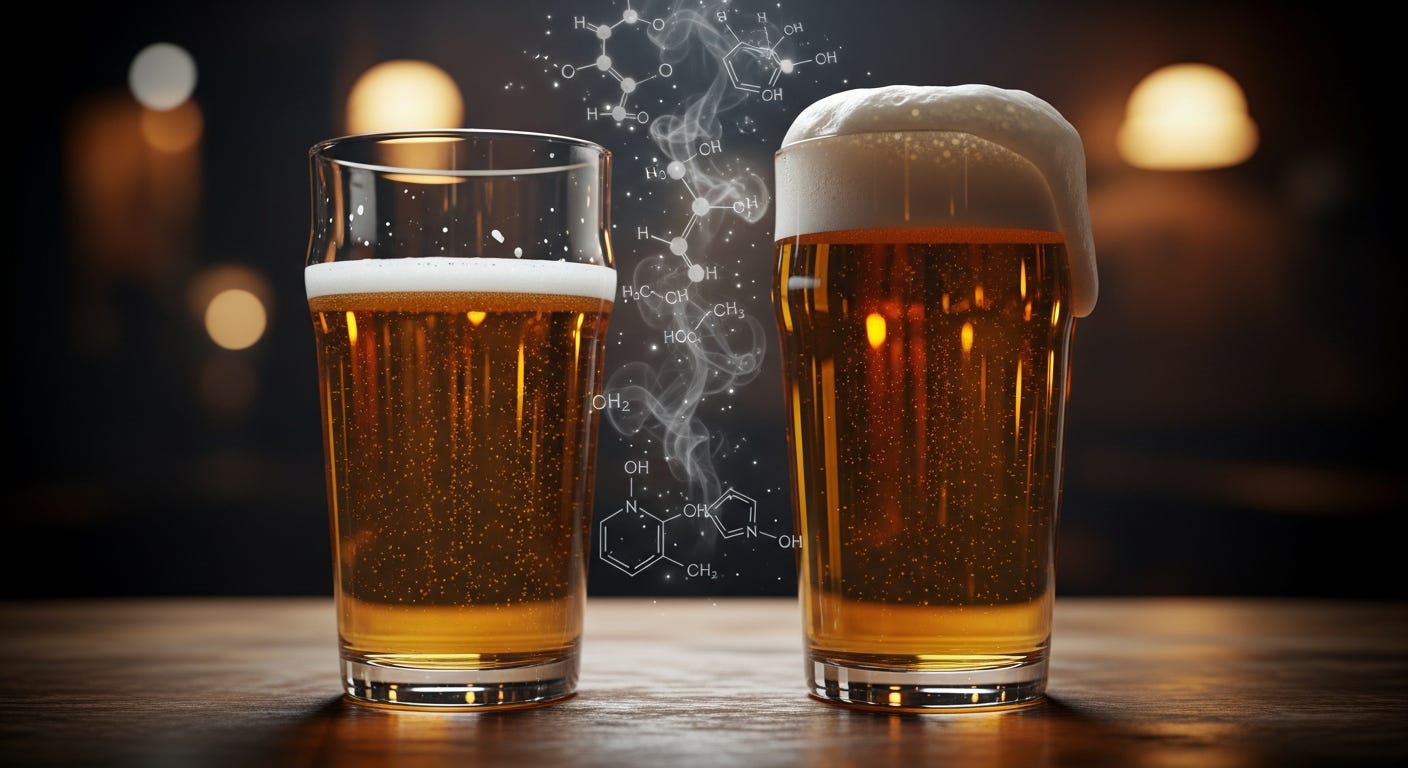
First, let’s get one thing straight
The biggest driver of any hangover is, and will always be, how much alcohol you consumed. Full stop. No amount of fancy ingredients or clever brewing will save you if you drink twelve beers. Scientists are pretty unanimous on this point, and anyone selling you a “hangover-free” drink is lying to your face.
But here’s where it gets interesting: at the same level of alcohol consumption, not all beers hit equally the next morning. And the reasons why are buried in the chemistry of how cheap beer is actually made.
The invisible passengers in your beer: congeners
When yeast eats sugar and produces alcohol, ethanol isn’t the only thing it makes. It also produces a cocktail of chemical byproducts things like methanol, acetaldehyde, fusel alcohols, acetone, and tannins. These are collectively called congeners, and they’re the uninvited guests at every drinking session.
Congeners aren’t all bad. Many of them are responsible for the color, aroma, and flavor complexity of your drink. A dark stout tastes like a dark stout partly because of its congener profile. But here’s the catch: many congeners are mildly toxic, and your liver has to work overtime to process them alongside the ethanol.
The theory goes like this: congeners compete with ethanol for your liver’s processing bandwidth. While your liver is busy breaking down the congeners, the ethanol and its toxic byproduct, acetaldehyde lingers in your bloodstream longer. The longer acetaldehyde hangs around, the worse you feel.
So why does cheap beer specifically make it worse?
This is where adjuncts enter the story.
Traditional beer has four ingredients: water, malted barley, hops, and yeast. That’s it. It’s actually the law in Germany the famous Reinheitsgebot of 1516 bans anything else. But mass-market cheap beer often swaps out a significant portion of the barley for cheaper alternatives like corn, rice, or corn syrup. These are called adjuncts.
Now, the macro-brewing industry will tell you adjuncts are used to create a lighter, more drinkable flavor and there’s some truth to that. But the biochemical consequences matter. These alternative sugars ferment differently than maltose from barley, and the fermentation process under industrial conditions rushed timelines, high temperatures, enormous batch sizes tends to produce higher concentrations of fusel alcohols and acetaldehyde per unit of alcohol.
In other words: cheap beer can pack more hangover-causing byproducts per sip, even at a lower ABV.
The filtration twist (this one’s counterintuitive)
Here’s something that will genuinely surprise you: heavily filtered beer isn’t necessarily better for your hangover.
Mass-market lagers go through aggressive industrial filtration diatomaceous earth, centrifugation, sometimes activated carbon which does strip out many volatile congeners. So far, so good. But this same process also removes polyphenols, which are natural antioxidant compounds from the barley and hops that actually help your body manage oxidative stress, one of the key mechanisms behind hangover symptoms.
So the cheap beer is simultaneously producing more toxic byproducts and stripping out the compounds that would help you cope with them. It’s a double loss.
Doesn’t craft beer have more congeners too?
Yes and no. This is where the story gets genuinely nuanced, and where a lot of people get it wrong.
Dark, complex craft beers: barrel-aged stouts, heavily dry-hopped IPAs, unfiltered wheat beers etc can absolutely carry a high congener load. A barrel-aged imperial stout at 12% ABV is not your friend the next morning, regardless of how artisanal the label looks.
But a well-made craft lager or pale ale, brewed with only traditional ingredients, at controlled fermentation temperatures, with no shortcuts that’s a different animal. The care taken in fermentation temperature control alone matters enormously. Yeast fermenting at too high a temperature produces dramatically more fusel alcohols, which is one reason industrial-scale brewing in giant vats can be so punishing.
The real variable isn’t “craft vs. cheap.” It’s ingredients + fermentation conditions + processing. Price is just a rough proxy for those things.
Busting Three Myths While We’re Here
Myth #1: “Beer before liquor, never been sicker.”
Completely false. Multiple clinical studies found zero correlation between the order you drink different alcohols and hangover severity. Total ethanol consumed is what matters, not the sequence.
Myth #2: “Light beer means lighter hangover.”
Not automatically. Many light beers achieve their low calorie count through extreme adjunct use up to 40% corn syrup in some cases aggressive filtration that removes protective polyphenols, and shortened fermentation that increases acetaldehyde. Their lower ABV can be offset by a higher congener density per gram of ethanol.
Myth #3: “It’s just dehydration.”
Dehydration is real and it contributes alcohol suppresses the hormone that tells your kidneys to retain water. But researchers have established that dehydration alone doesn’t explain the full picture of hangover symptoms. Acetaldehyde toxicity, immune system activation, blood sugar disruption, and yes, congeners, all play a role.
The practical takeaway (without being preachy about it)
You don’t need to become a craft beer snob to drink smarter. A few genuinely useful things to know:
Read the label. Beers that list only “water, barley malt, hops, yeast” are giving you the full picture. The moment you see corn syrup, glucose, or “natural flavors,” you know shortcuts were taken.
ABV is your most honest guide. A 4% beer is a 4% beer. Don’t let the price fool you into drinking more of it.
Darker doesn’t always mean worse. A dark craft beer made with quality ingredients and careful fermentation can be kinder to you than a pale industrial lager.
Hydration helps, but it’s not magic. Water before bed is good. It won’t neutralize acetaldehyde. Manage your expectations.
The Bottom Line
The reason that £3 can sometimes wrecks your morning isn’t a mystery or bad luck. It’s the predictable result of industrial shortcuts: cheaper ingredients, faster fermentation, aggressive processing that leave your liver dealing with a messier chemical cocktail than it would from a more carefully made beer.
Science still has plenty to learn about hangovers. But what it does know points clearly in one direction: what’s in your beer matters, not just how much of it you drink.
Next time you’re standing at the cooler deciding between the cheap 12-pack and something that costs twice as much, you’re not just making a taste decision. You’re making a biochemistry decision.
Choose wisely.
Because I drink a gallon of it instead of a pint?
It's why I've mainly stuck to traditional cask conditioned real ale for over 50 years. The Seaforth Corn Mill in Liverpool used to supply the maize grits to Kellogg's from which Corn Flakes, Frosties etc. are made. The smaller pieces of processed maize were classified as Brewers Grits. These were sold to the makers of ''industrial scale'' lagers.